

BLOG DETAIL
- Unitech Solution
- 21 Aug 2026
The Blueprint for Modern Visibility: Integrating Technical SEO, AEO, and GEO in the Age of AI Search
The digital discovery landscape is experiencing its most volatile evolution since the dawn of commercial search engines. Traditional search engine optimization (SEO), which historically focused on securing a placement within a linear list of ten blue organic links, is no longer the sole benchmark for enterprise visibility.
With the explosive integration
of Large Language Models (LLMs) into mainstream search interfaces, users
increasingly bypass standard web browsing entirely. Instead, they rely on
synthesized, conversational multi-paragraph responses generated directly within
platform interfaces.
To maintain organic market
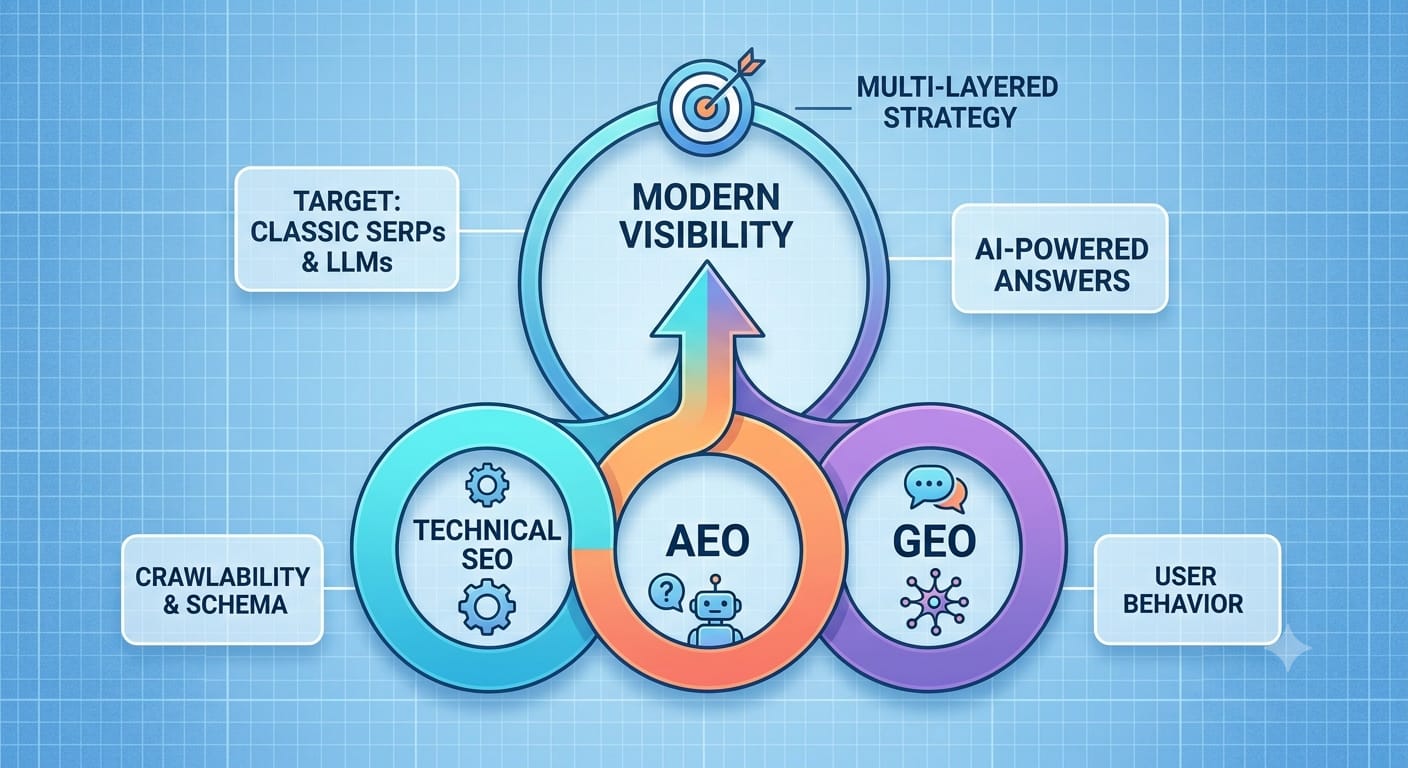
share, digital brands must implement a multi-layered optimization strategy.
This framework bridges the gap between classic technical optimization, Answer
Engine Optimization (AEO), and Generative Engine Optimization (GEO).
Below is an exhaustive tactical
guide detailing how to build an authoritative, machine-readable digital
ecosystem that ranks on traditional SERPs while capturing real-time citations
across generative models.
1. Mapping the Paradigm Shift:
SEO vs. AEO vs. GEO
Understanding the modern search
ecosystem requires a clear distinction between the three primary pillars of
digital visibility. While they share a foundational reliance on high-quality
web crawling, their optimization objectives, delivery mechanics, and primary
performance indicators differ significantly.
The core objective of modern
search strategy is to shift from merely ranking a webpage to becoming the
definitive, extracted answer across all search surfaces.
|
Optimization Pillar |
Core Objective |
Primary Interfaces |
Key Performance Metrics |
|
Search Engine Optimization
(SEO) |
Secure ranked positions for
target URLs in standard query result listings. |
Traditional Google, Bing,
Yahoo SERPs. |
Organic Sessions, Keyword
Rankings, Click-Through Rate (CTR). |
|
Answer Engine Optimization
(AEO) |
Structure brand data to serve
as the immediate, extracted direct answer for precise informational queries. |
Featured Snippets, People Also
Ask (PAA) blocks, Voice Assistants. |
Zero-Click Impression Share,
Direct Mention Volume, Quick Answers Surfaced. |
|
Generative Engine Optimization
(GEO) |
Optimize digital footprints to
secure inline citations and authoritative mentions across large-scale AI
synthesis models. |
AI Overviews, Conversational
Chat Engines, Generative Discovery Tools. |
Share of Model, Citation
Authority, Domain Influence Score, Sentiment Distribution. |
2. Pillar 1: The Non-Negotiable
Technical Foundation
An AI model or standard search
engine crawler cannot index or synthesize content it cannot efficiently access.
Technical SEO is the infrastructure upon which all subsequent AEO and GEO
tactics are executed. Building a flawless code-to-content pipeline ensures that
bots maximize their assigned crawl budget and interpret site structure without
friction.
Core Web Vitals and Page
Experience
Page speed and user experience
metrics directly influence crawl frequency. Websites must systematically audit
and resolve issues related to:
- Largest
Contentful Paint (LCP):
Optimizing server response times and lazy-loading non-critical media
resources to ensure visual content renders immediately.
- Interaction
to Next Paint (INP):
Minimizing main-thread blocking scripts to provide an instantaneous
interface response when users interact with the site.
- Cumulative
Layout Shift (CLS):
Ensuring all visual elements maintain structural stability during page
initialization to eliminate unexpected layout movement.
Crawlability and Indexation
Management
To prevent search engines from
wasting resources on low-value URLs, technical architectures must feature clean
XML sitemaps, properly configured robots.txt directives, and explicit canonical
tags.
Eliminating orphan pages,
resolving internal server errors (5xx codes), and rectifying broken redirect
chains (4xx codes) ensures that search bots seamlessly discover your most
valuable content sprouts.
Passage-Level Semantic
Optimization
Modern search engines and
conversational interfaces process data in distinct chunks and sections rather
than evaluating an isolated webpage as a singular block.
Implementing a rigid heading
hierarchy (H1,
H2,
H3)
that maps out explicit thematic shifts allows algorithms to extract specific
passages for real-time synthesis.
3. Pillar 2: Answer Engine
Optimization (AEO) Execution
Answer Engine Optimization
relies on extreme brevity, linguistic precision, and upfront data delivery.
When optimizing for featured snippets or quick conversational answers, content
creators must ditch creative fluff and lead with immediate intent matching.
The "Inverted Pyramid"
Writing Style
To maximize AEO extraction
potential, structure every informational subsection using a strict three-part
layout:
- The
Question-Based Heading:
Utilize highly specific, question-based long-tail phrases within your
formatting tags. For example: “What is the primary benefit of
structured data for AI search engines?”
- The
Direct Target Answer: Write
a concise, 2-to-3 sentence declarative definition immediately below the
heading. This block must stand completely alone without relying on
external context.
- The
Supporting Contextual Narrative:
Provide deeper analysis, historical reference, and authoritative data
directly following the short definition to satisfy users who choose to
read further.
Designing for Enumerable
Extraction
AI search engines consistently
prioritize clear lists, structured comparison tables, and ordered bullet points
when formatting direct answers for users.
When explaining processes,
technical workflows, or multi-variable selections, always deploy clean markdown
lists or concise tables. This drastically reduces the cognitive load required
for an AI system to accurately parse and scrape your data.
4. Pillar 3: Generative Engine
Optimization (GEO) Framework
Generative Engine Optimization
is the practice of formatting content to ensure your brand is selected as an
inline citation asset within AI-synthesized responses.
Because generative models
cross-reference information across billions of parameters, your off-site
digital footprint matters just as much as your on-page copy.
Constructing Uncopyable
Prophetic Content Assets
To earn consistent citations,
content must transcend simple keyword inclusion. LLMs prioritize authoritative
information that introduces fresh perspectives, proprietary data, or unique
industry frameworks.
Publishing verified internal
case studies, original statistical research, and actionable breakdowns makes
your domain a critical reference point that AI models must cite to remain
accurate.
Direct Entity Mapping and Brand
Association
AI models understand the web
through entity graphs—complex networks connecting concepts, organizations,
people, and locations.
To build strong entity
associations with your core offering, focus on earning real, high-quality
third-party mentions across industry publications, respected digital forums,
and authoritative interview platforms.
When external web properties
consistently group your brand alongside specific technical solutions, LLMs
learn to synthesize your business as an industry-standard recommendation.
Multi-Modal Integration for
Comprehensive Matching
Generative search interfaces are
fundamentally multimodal. They frequently surface contextual images,
instructional video segments, and detailed infographics alongside text
summaries.
Every comprehensive guide must
feature high-definition visual elements backed by highly descriptive alt text,
clean metadata, and relevant text captions. This broadens your citation entry
points across text, visual, and video discovery models alike.
Conclusion: Future-Proofing Your
Organic Strategy
The convergence of technical
health, direct answer structuring, and generative authority optimization forms
the ultimate blueprint for sustainable digital growth.
By creating structurally
pristine websites that speak the language of both human searchers and
machine-learning crawlers, brands secure valuable real estate across all
present and future search surfaces.
Partner With an Expert to
Future-Proof Your Visibility
Navigating the complexities of
traditional indexing alongside advanced Generative Engine Optimization requires
a data-driven, systematic approach. As an experienced AI SEO Consultant, I specialize in auditing core technical
architecture, mapping conversational user intent, and implementing robust
visibility frameworks that safely pass authority back to your primary domain.
If you are ready to eliminate
technical bottlenecks, amplify your organic traffic pipeline, and ensure your
brand is cited as a definitive industry authority, explore my tailored search
strategies and book your comprehensive consultation directly at Sheikh
Sabbir Hossain - AI SEO Specialist.